HPNeuroLight

Translated 5 EEG bands into 3 legible brain states and built a working hardware prototype that helps gamers regulate stress mid-match, informed by 19 interviews.

Jump to deliverable
RoleAI UI/UX Designer
TeamDaniel Lee, Miles Roper, Subat Abuduaini, Edna Ho
ToolsFigma, Cursor, Muse 2 EEG, Chat-GPT API
Year2026
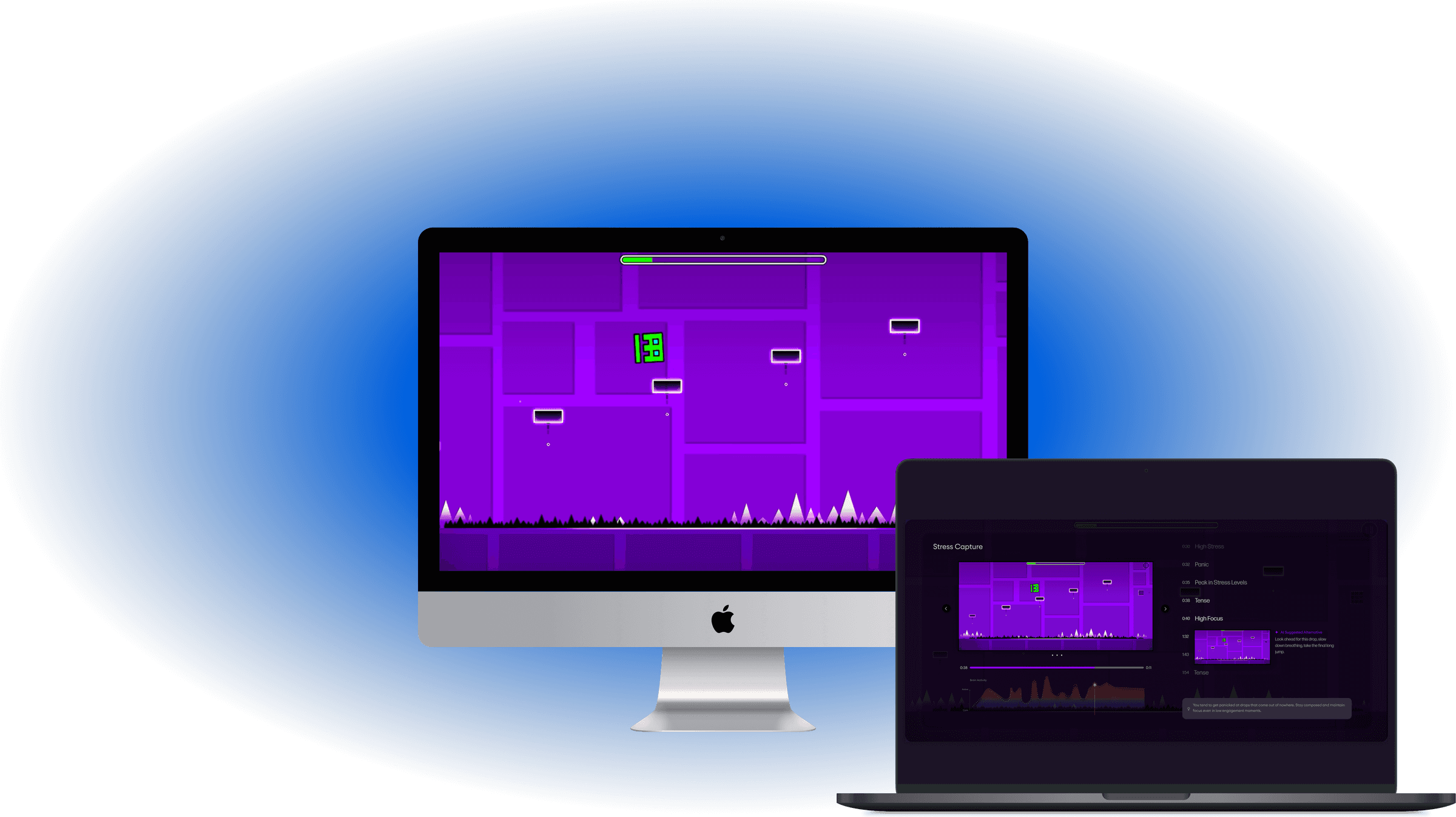
NeuroLight in play — the game with the blue calming glow on an iMac, and the Stress Capture post-game summary on a laptop

PROLOGUE: Innovating Gameplay Performance

PROLOGUE: Innovating Gameplay Performance

I can hit these shots. So why do I choke when it counts?

I can hit these shots. So why do I choke when it counts?

Meet Chris

He loves playing video games in his spare time and spends hours in competitive lobbies, trying to become a better player than he was the day before. But these days, something is holding him back, as if he’s unable to hit the same marks he usually does.
Chris — illustrated avatar

Over the Spring 2026 semester at UC Berkeley as a part of a Human-AI Design course, our team of four partnered with HP to rethink what gaming technology can measure, moving past traditional hardware performance metrics toward an experience that interprets neural signals in real time with the ultimate goal of improving gameplay performance.

My hands were all over the pipeline: shaping interview questions, synthesizing research, ideating solutions, prototyping screens in Figma and front-end code, and integrating the Muse 2 headband into the system architecture.

THE DESIGN QUESTION

How might we enhance the gaming experience for power gamers with a neurotechnology-integrated wearable that sharpens focus and deepens immersion through real-time cognitive feedback?

How might we enhance the gaming experience for power gamers with a neurotechnology-integrated wearable that sharpens focus and deepens immersion through real-time cognitive feedback?

ACT I: Research

ACT I: Research

Watching players under pressure

Watching players under pressure

I observed and interviewed 19 players like Chris across the competitive spectrum, and three findings steered everything we built.
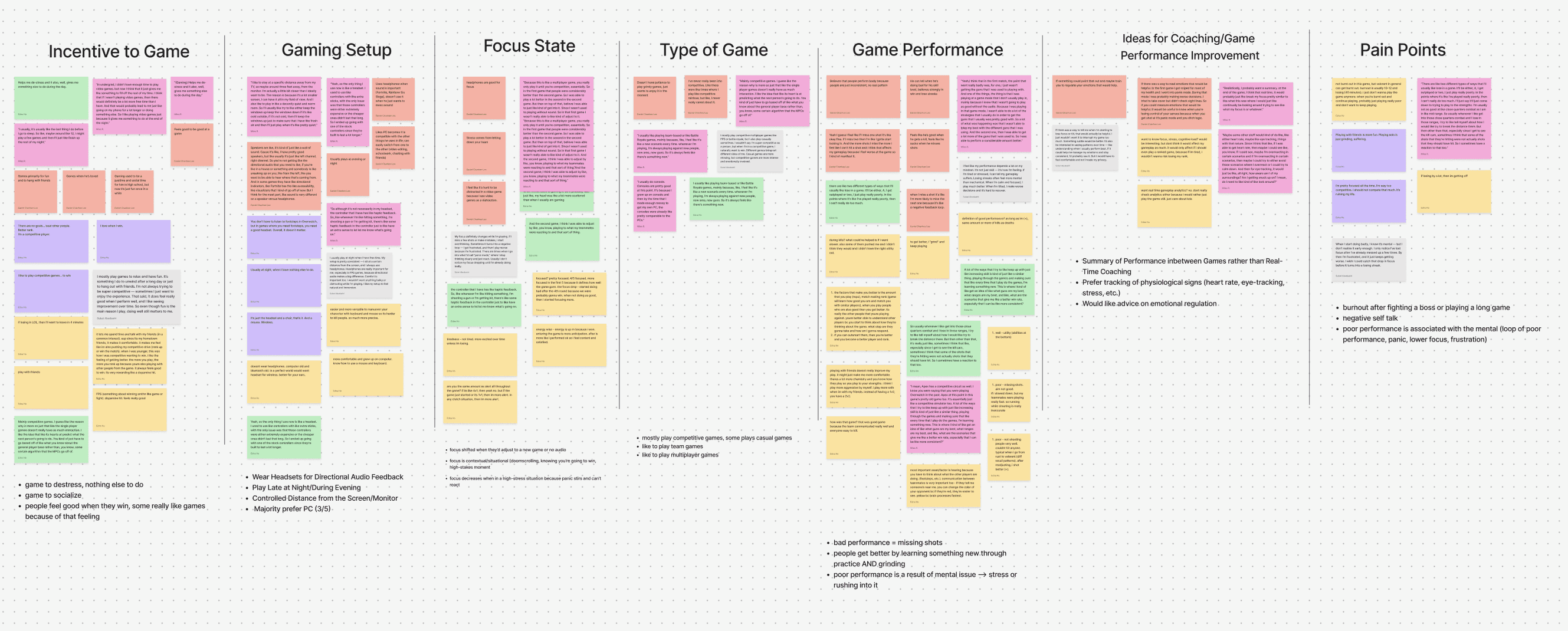
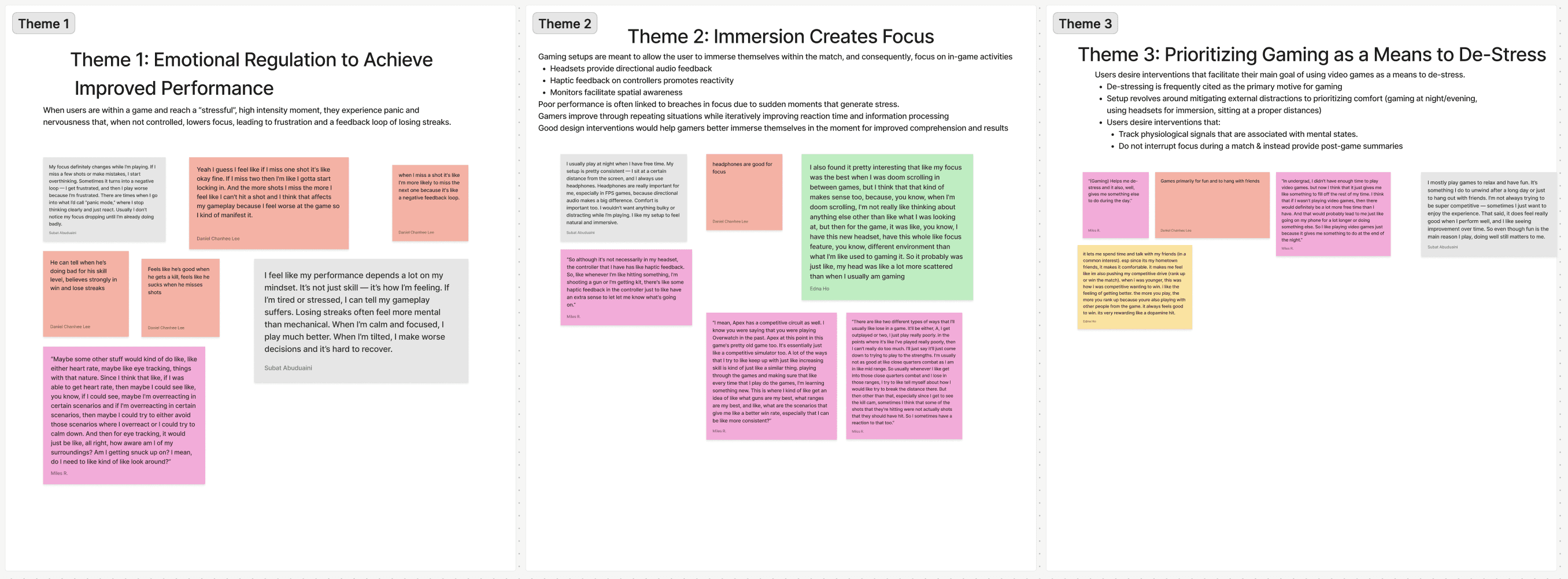
Research Synthesis
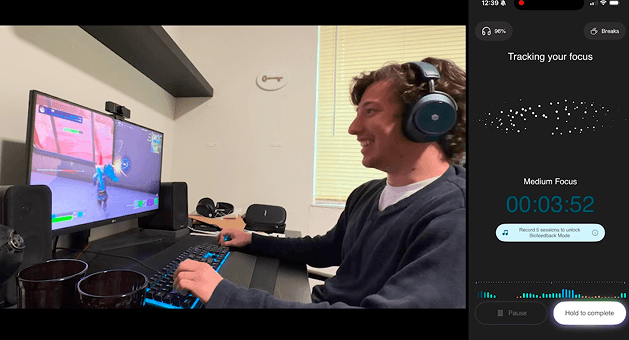
Observation session — a participant plays with the Muse headband on while the Muse app tracks focus

Putting an interviewee under a prototype EEG headset

01

Emotion drives performance

Players experience emotional volatility during high-intensity gameplay, where frustration negatively impacts focus and performance more than mechanical skill alone.

02

Immersion & Focus

Players create immersive gaming setups to improve focus and reaction time, with audio and haptic feedback helping maintain awareness and engagement.

03

Gaming as Stress Relief

For many players, gaming is a way to relax, decompress, and socialize, though competitive pressure can sometimes conflict with these goals.

Players wanted to improve and stay competitive, but they also wanted gaming to remain enjoyable and stress-relieving.

SYNTHESIS — USER RESEARCH

ACT II - Ideation

ACT II - Ideation

Narrowing to what we could build

Narrowing to what we could build

Ideation ranged wide. Using Chat-GPT’s experimental API, I stretched the concept space to 10 ideas, then narrowed hard to 2 against our timeline and technical constraints.
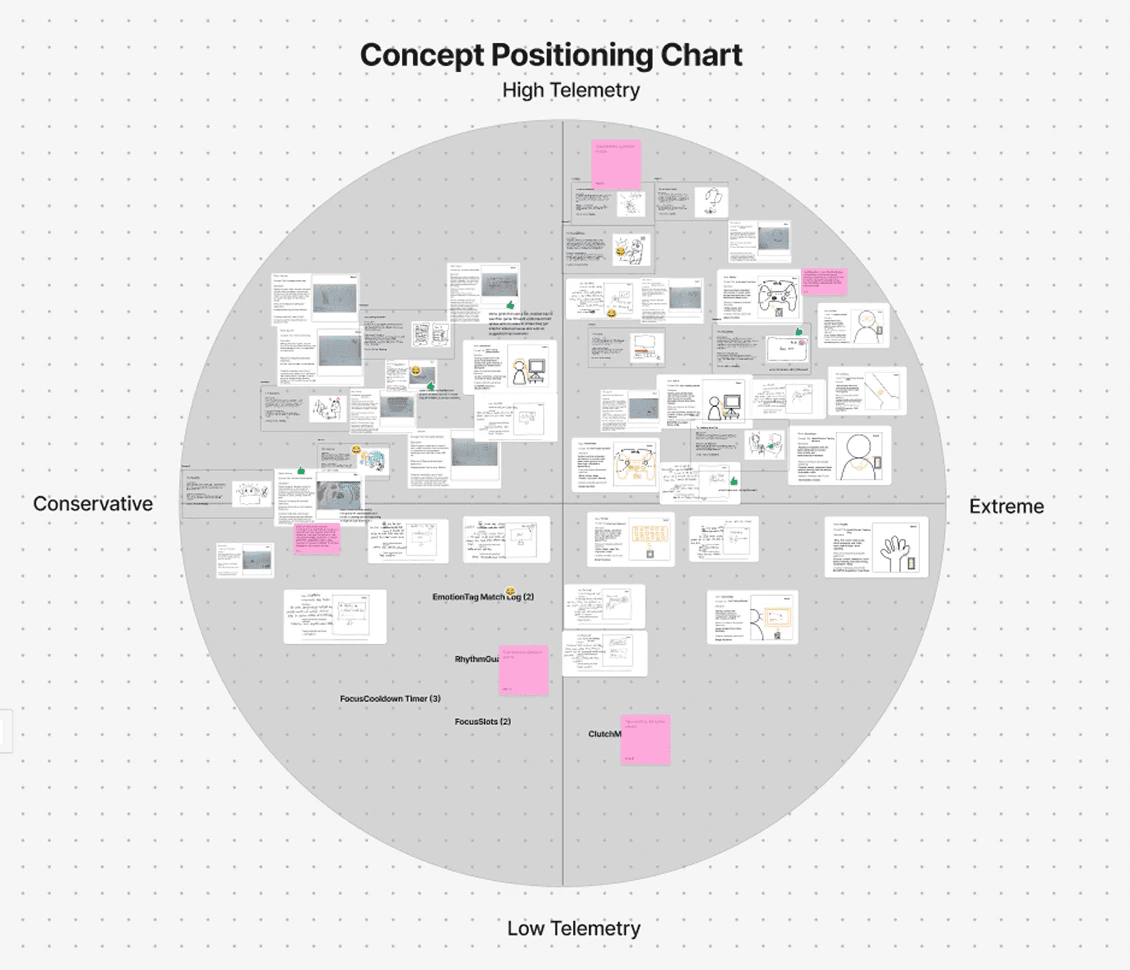
Concept positioning chart — conservative to extreme, low to high telemetry
Concept cards01 / 10
01 — Snapshot Coach
02 — Heart Monitor Headset
03 — Desaturator
04 — Full Immersion
05 — Flow State
06 — Health Bar
07 — Inflating Green Orb
08 — AI Coach Bot
09 — Gaming Coach App
10 — Responsive Mouse

Using AI tools to evaluate our concepts based on usefulness, feasibility, and clarity, the team settled on a combination of these two initial ideas to further develop.

IDEA 1

Surround Visual Lighting

During the game, the lights mirror the colors and action on the screen for immersion. In moments of distress or potential negative snowballing, the lighting changes to a slow, calming breath-like glow.

IDEA 2

AI Coach Bot

Using all of the brain data from the headset EEG, an AI agent appears at the end of every game with a detailed summary of the performance based off of past experiences, with prompts that allow the user to explore more about a specific error or trend that they want to learn about.

01

EEG as input

Alpha and beta activity estimate mental states (calmness, alertness, stress, and loss of focus) while the player simply plays.

02

Feedback that whispers

When the system detects overwhelm, the interface shifts toward blue tones and offers short, supportive prompts — a reset, not an interruption.

03

Summaries, not scolding

AI-generated post-game summaries turn a session’s cognitive data into takeaways players can actually act on next match.

Feedback loop

Feedback loop

I connected Muse headband data through MuseLSL and used alpha/beta activity to estimate user’s state. The system creates a simple loop:
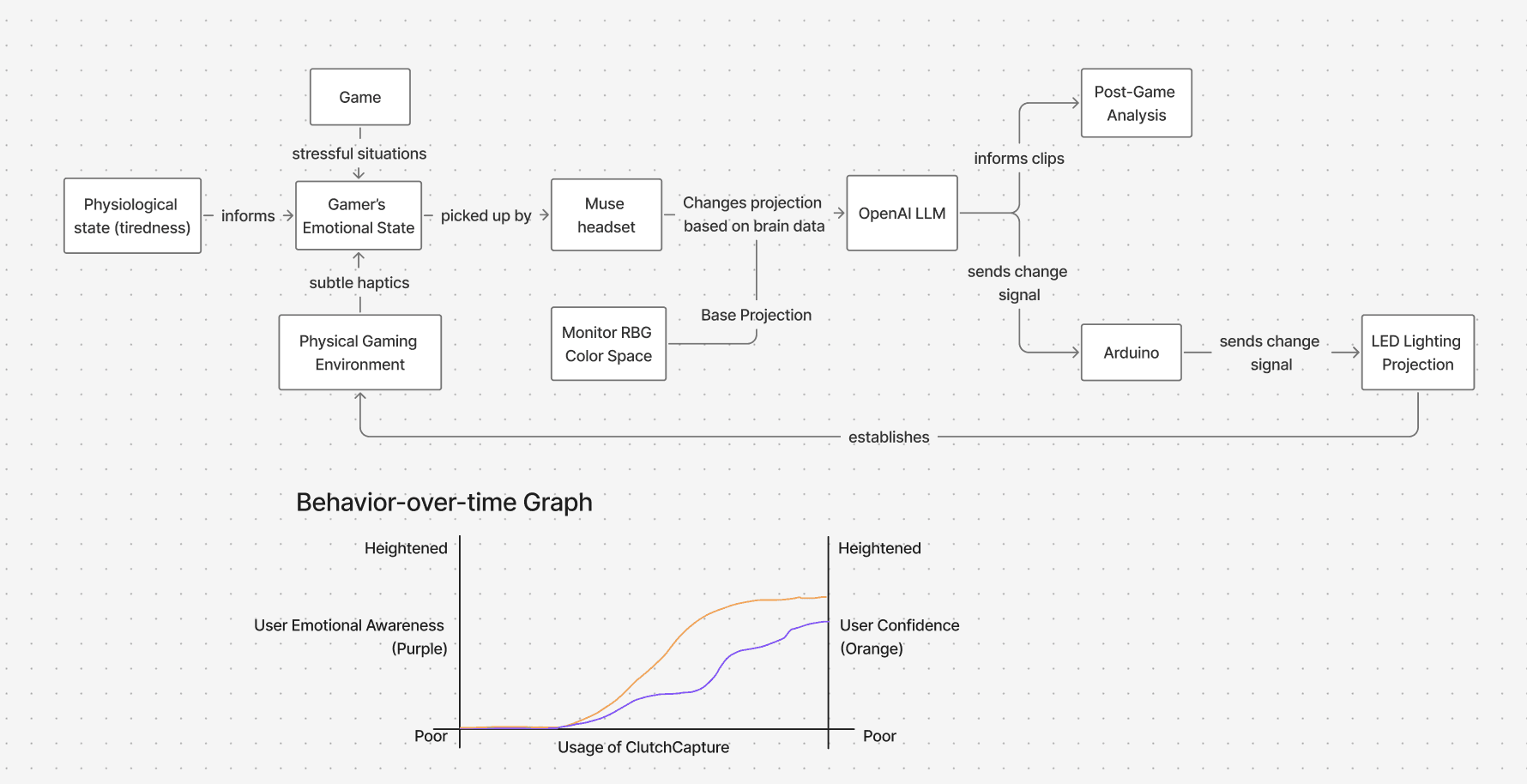
NeuroLight system feedback loop and behavior-over-time graph

Feedback loop diagram

Demo of feedback loop

EEG signal → state detection → screen color feedback
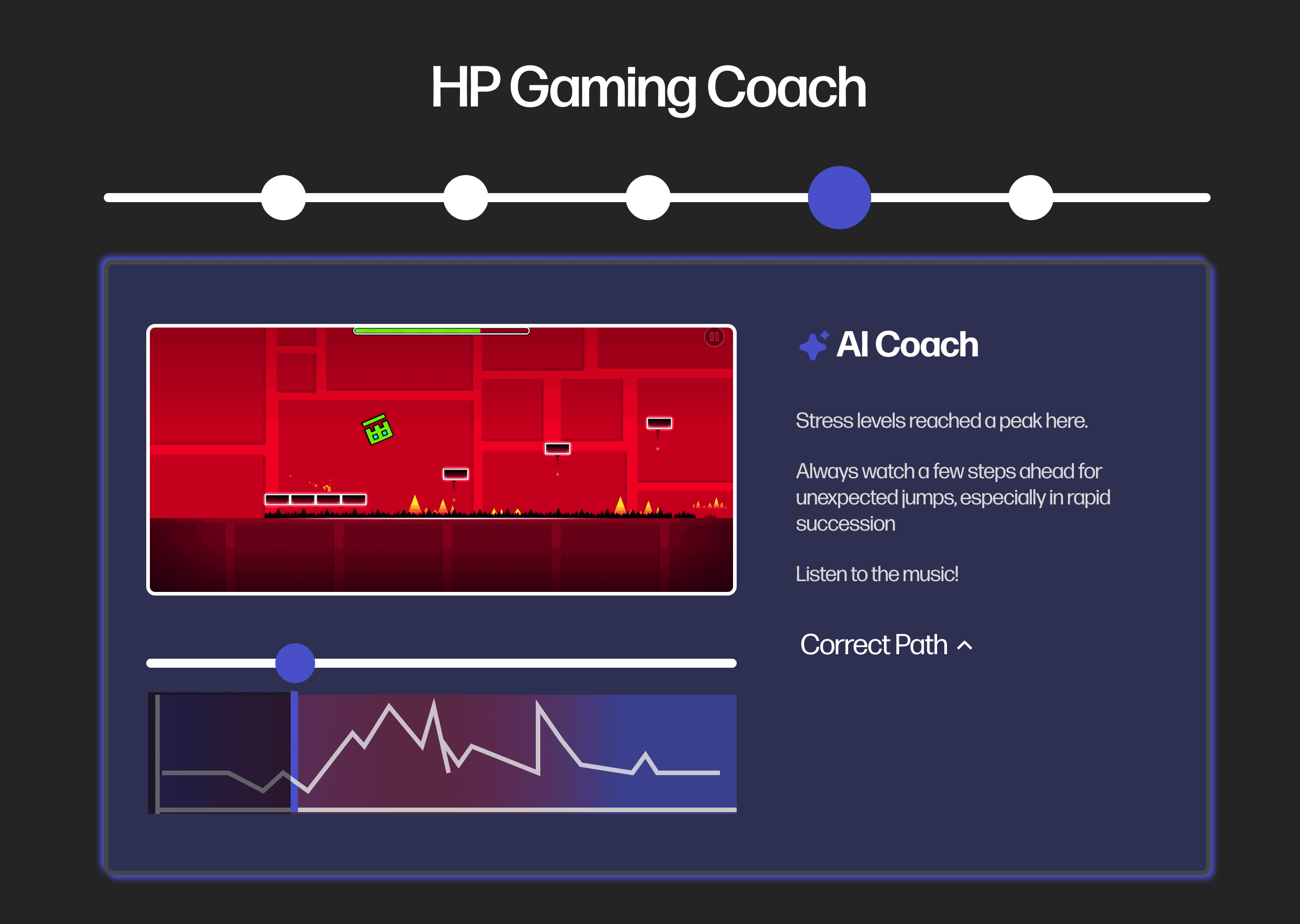
Mid-fi screen Prototypes

Mid-fi screen Prototypes

01 · Gaming Coach review screen
■01 · Gaming Coach review screen
02 · Stress Capture timeline
■02 · Stress Capture timeline
03 · Stress Capture event list
■03 · Stress Capture event list

Mid-fi prototypes for the post-game AI summary
drag to rearrange

drag to rearrange

Act 3: Final Prototype

Act 3: Final Prototype

NeuroLight × HP

The final prototype pairs the Muse 2 headband with an on-screen companion. As alpha and beta activity shift, NeuroLight estimates whether a player is calm, alert, stressed, or losing focus — and answers in the quietest way that works: the interface cools toward blue and a short supportive prompt helps the player reset mid-game.

After the session, an AI-generated summary translates the run’s cognitive data into plain-language takeaways. We built it as a working prototype — physical hardware included.
NeuroLight in play — the game with the blue calming glow on an iMac, and the Stress Capture post-game summary on a laptop

Reading Brain Waves

The Muse headset collects Delta, Theta, Alpha, Beta, and Gamma waves that are essential in emotion capture during gameplay. NeuroLight synthesizes the Alpha-Beta ratio in order to detect “active” brain states such as “calm”, “alert”, and “stressed”.

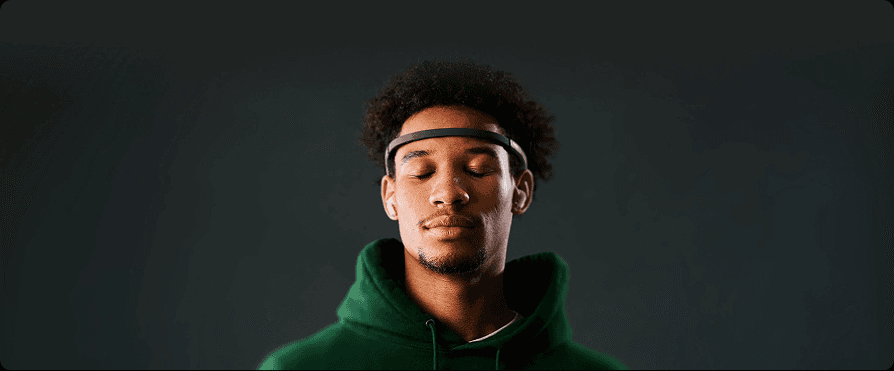
Muse 2 headset worn during play

Predicting the Spiral

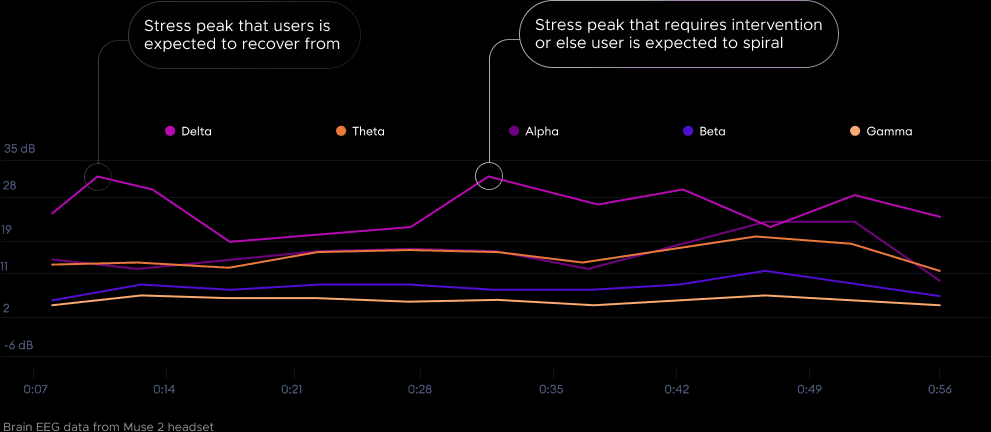
Based on users’ previous brain activity, OpenAI’s LLM receives the current game’s brain activity and predicts the stress-peaks where the user tends to experience a negative spiral. Gamers should only receive intervention in these moments.

Brain EEG data from the Muse 2 headset with stress peaks annotated

In-Game

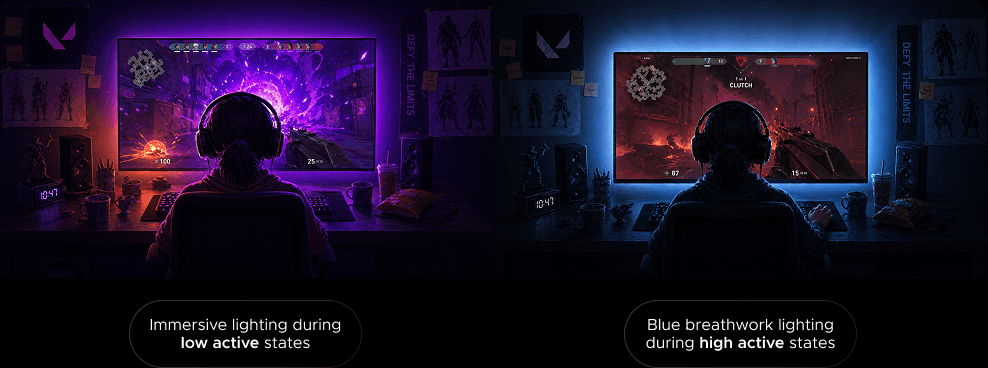
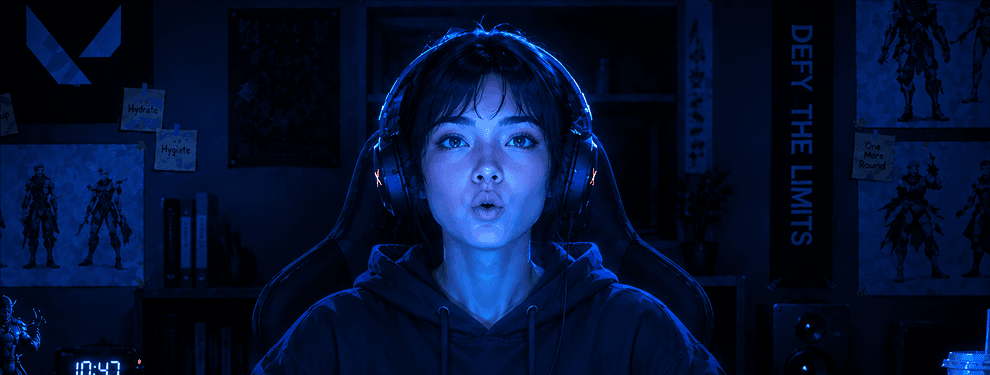
Immersive lighting extends the game onto the wall, and the same lights carry a breathwork blue glow. During high-stress moments it quietly signals the gamer to calm, refocus, and take control without pulling them out of the screen.

In-game: immersive lighting during low active states, blue breathwork lighting during high active states

Post-Game

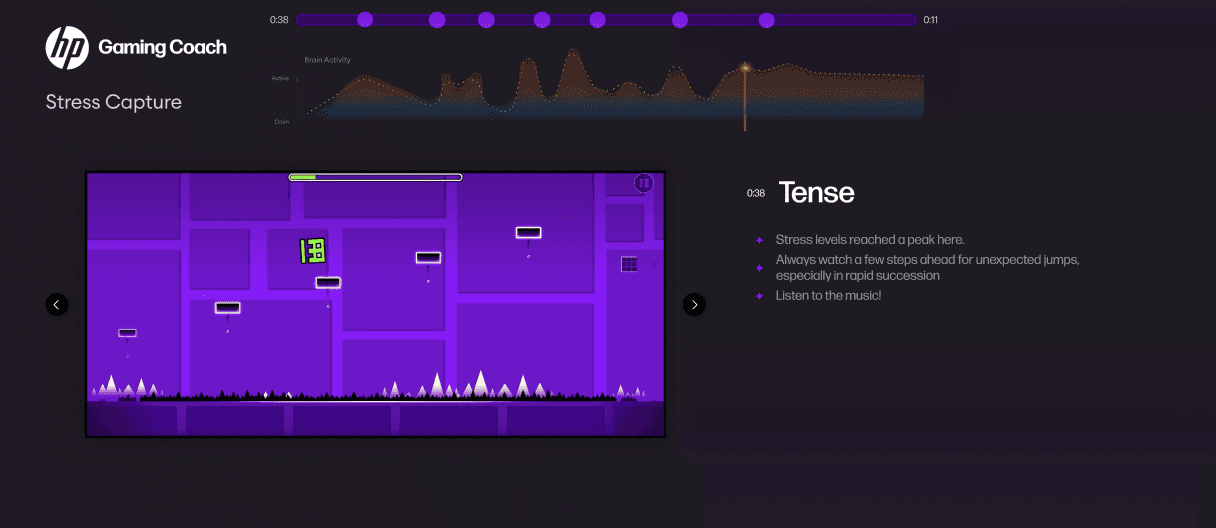
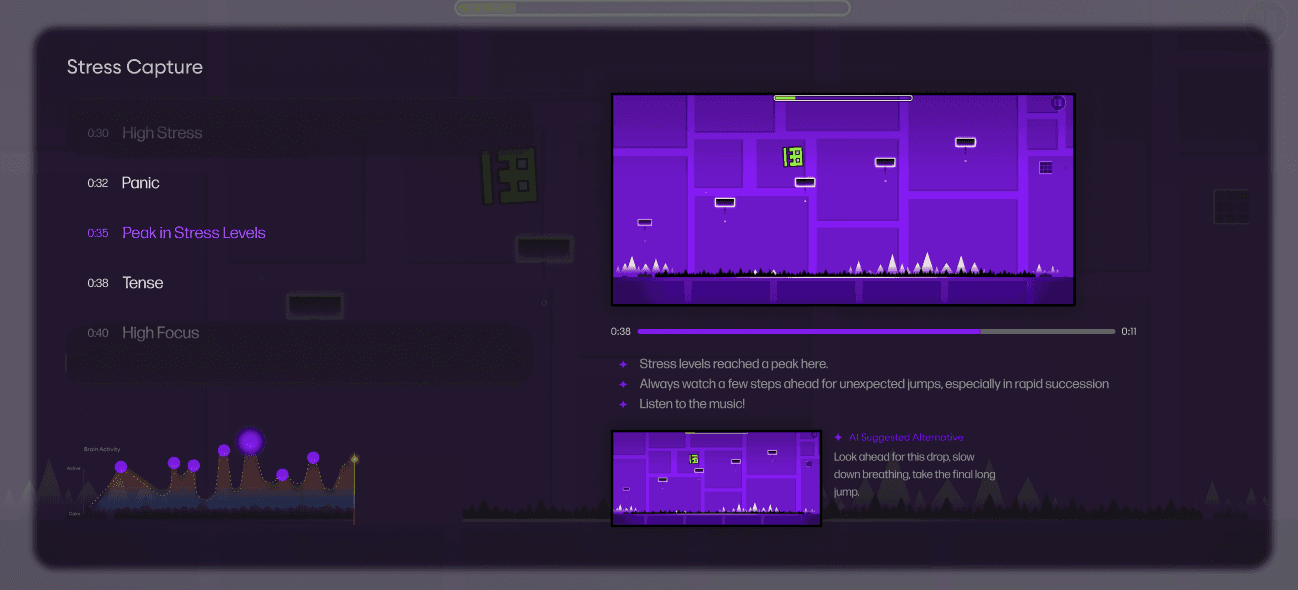
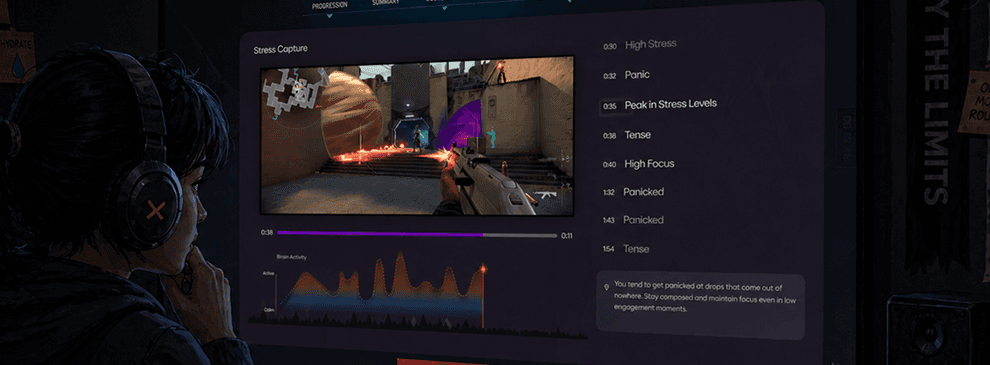
After the session, players get the game clip that matches each stress-peak. Seeing the panic that led to a death makes the case for regulating in those moments, and gives them insight to leverage in future games.

Post-game: stress capture timeline with the matching gameplay clip

Loop Behavior

Working as intended, the loop raises emotional awareness, shortens the time it takes to regulate, and shows gamers how their emotions shape their play. That encourages healthier, longer sessions, better teammate interactions, and stats that climb over time.

A calmer player under NeuroLight’s blue glow

Reading Brain Waves

The Muse headset collects Delta, Theta, Alpha, Beta, and Gamma waves that are essential in emotion capture during gameplay. NeuroLight synthesizes the Alpha-Beta ratio in order to detect “active” brain states such as “calm”, “alert”, and “stressed”.

Muse 2 headset worn during play

Predicting the Spiral

Based on users’ previous brain activity, OpenAI’s LLM receives the current game’s brain activity and predicts the stress-peaks where the user tends to experience a negative spiral. Gamers should only receive intervention in these moments.

Brain EEG data from the Muse 2 headset with stress peaks annotated

In-Game

Immersive lighting extends the game onto the wall, and the same lights carry a breathwork blue glow. During high-stress moments it quietly signals the gamer to calm, refocus, and take control without pulling them out of the screen.

In-game: immersive lighting during low active states, blue breathwork lighting during high active states

Post-Game

After the session, players get the game clip that matches each stress-peak. Seeing the panic that led to a death makes the case for regulating in those moments, and gives them insight to leverage in future games.

Post-game: stress capture timeline with the matching gameplay clip

Loop Behavior

Working as intended, the loop raises emotional awareness, shortens the time it takes to regulate, and shows gamers how their emotions shape their play. That encourages healthier, longer sessions, better teammate interactions, and stats that climb over time.

A calmer player under NeuroLight’s blue glow
Jacobs Design Showcase — May 202601 / 06
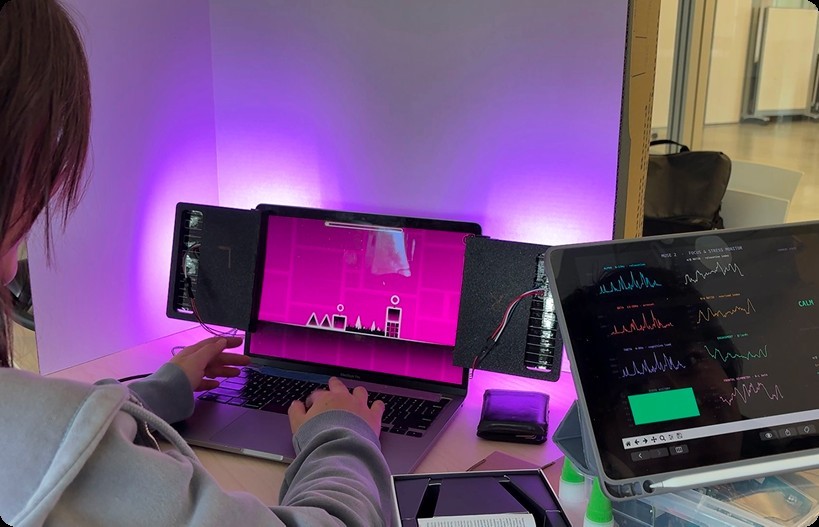
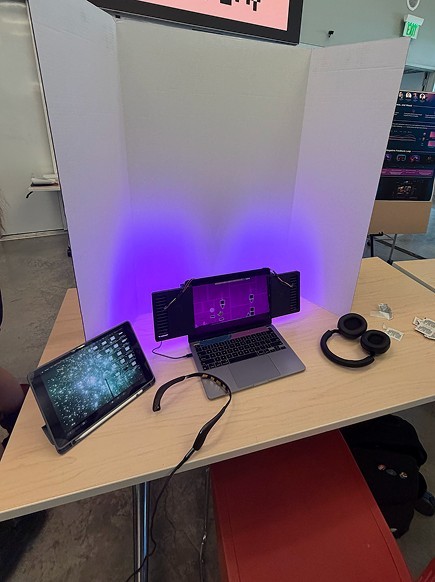
Showcase rig — laptop, LED panels and the Muse 2 dashboard
The rig — laptop, LED panels, Muse 2 dashboard
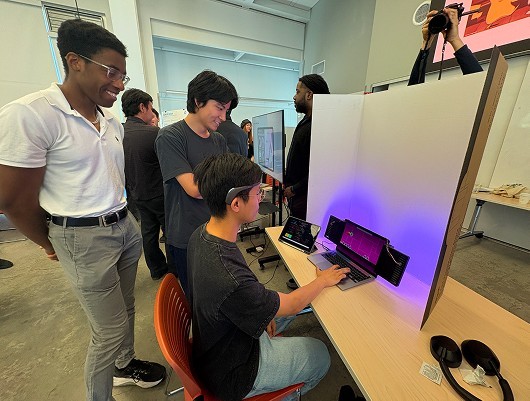
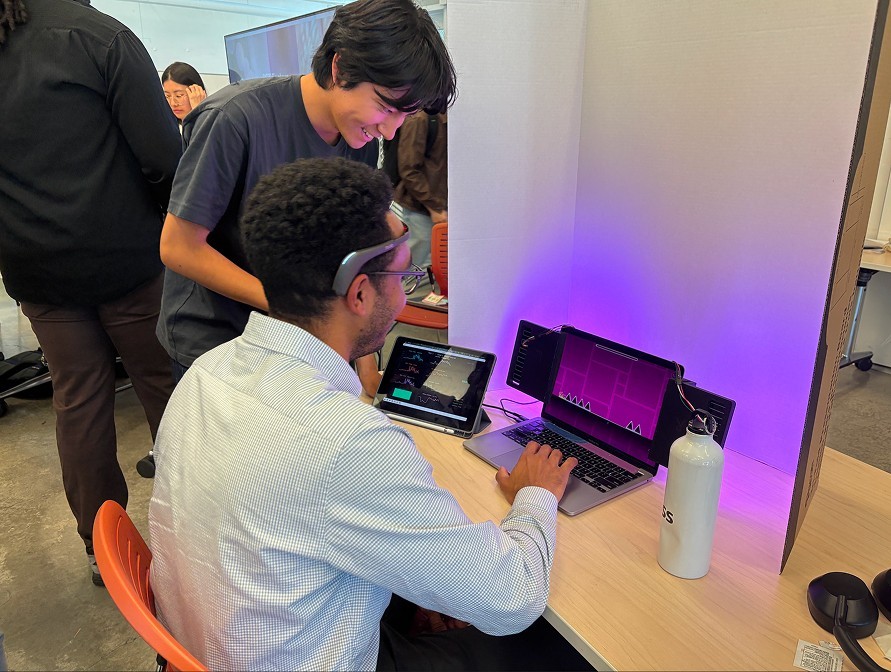
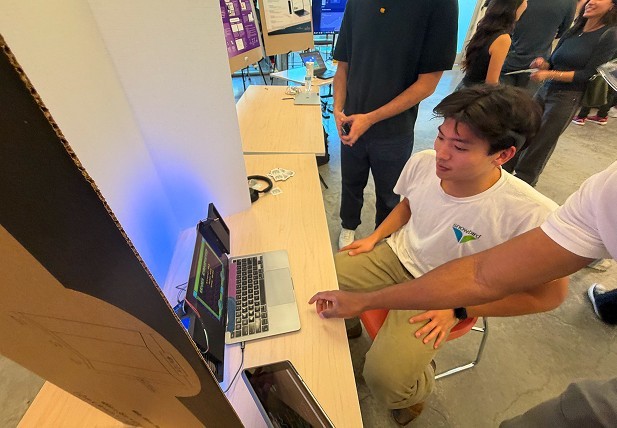
Visitors trying NeuroLight at the Jacobs Design Showcase
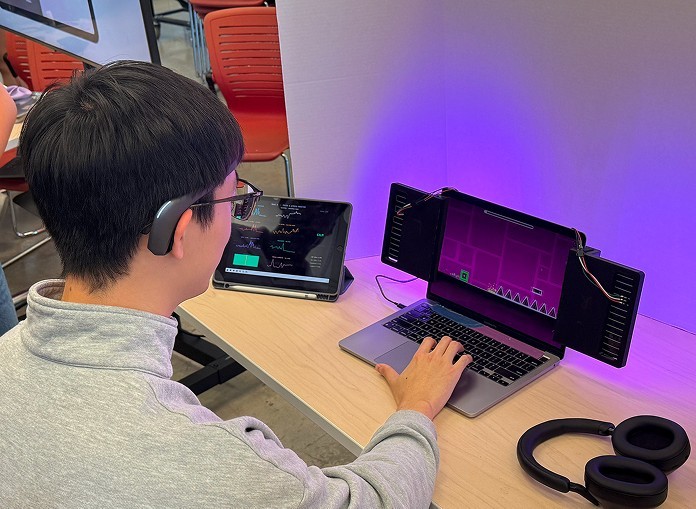
A visitor plays with the Muse 2 headband on while EEG streams to the tablet
Headband on, EEG streaming to the tablet
The NeuroLight setup between sessions
The setup between sessions
Live brain-state readout on the tablet beside the game
Live brain-state readout beside the game
Walking a visitor through the prototype

EPILOGUE

EPILOGUE

Reflecting on the project

Reflecting on the project

Working with physical hardware was new territory for me, but planning around the implications of every design decision made the path to a working prototype feel smooth and logical. Syncing with my teammates and our HP mentor showed me how design actually moves in a group setting, with 2-week, user-tested iteration cycles being essential in our overall direction. Next, I would run more play-testing to tune how early and how gently NeuroLight should step in. Overall, I am extremely proud with how much our team accomplished over the course of one semester!
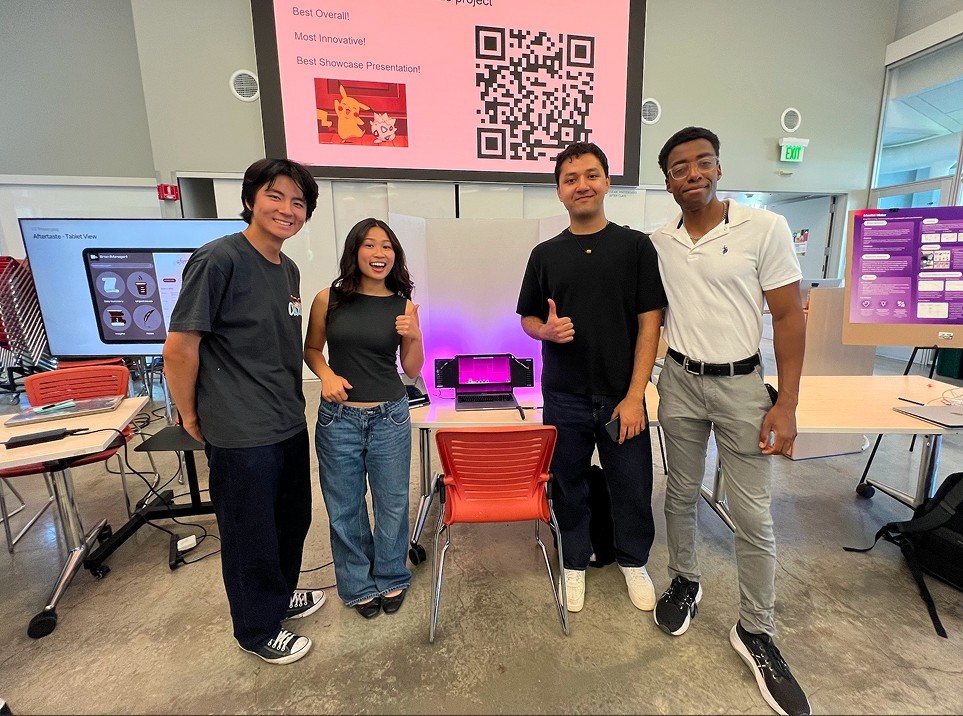
The NeuroLight team at the Jacobs Design Showcase
Illustrated avatar — smiling with glasses

The NeuroLight team at the showcase

PROJECT ROADMAP — JANUARY TO MAY 2026
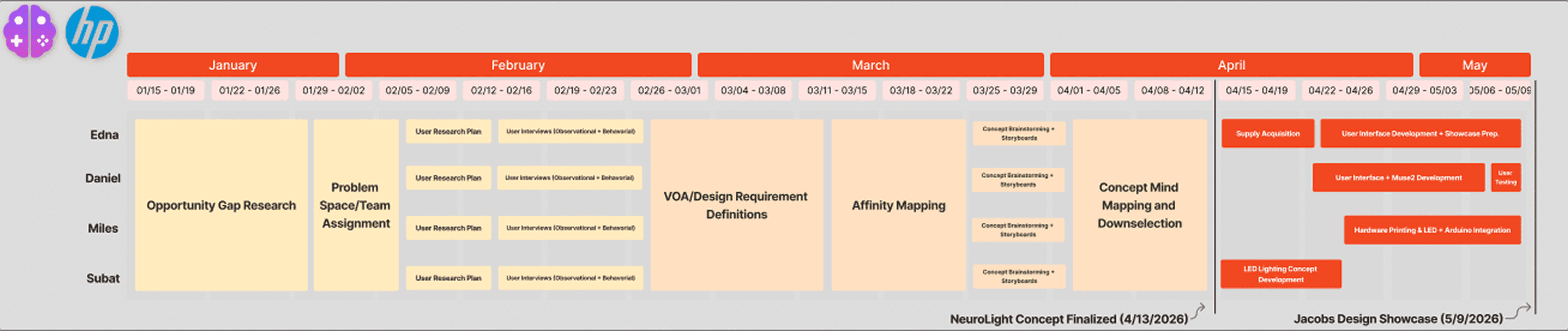
Project roadmap, January to May 2026 — research, VOA, affinity mapping, concept downselection, build, showcase